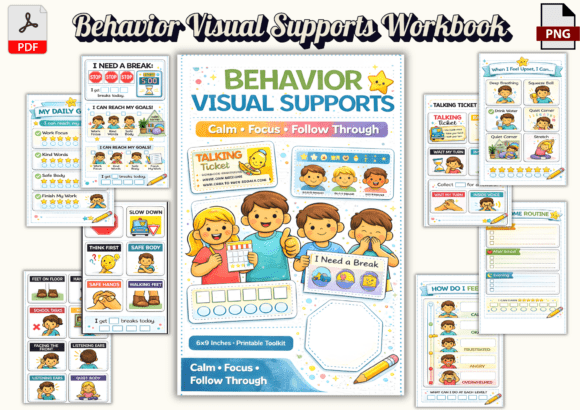
Mastering Behavior Visual Supports Workbook
In the world of design and content creation, we often focus on aesthetics, but the true measure of success is communication. For special education teachers, parents of children with autism, or therapists managing sensory needs, clarity isn't just a preference—it's a requirement. The Behavior Visual Supports Workbook isn't just another set of printables; it is a strategic communication tool designed to bridge the gap between anxiety and understanding. Much like a carefully curated set of design assets, this toolkit provides the visual language necessary to help children build self-regulation, independence, and positive behavior.
When we talk about modern typography and visual hierarchy in the context of behavioral support, we are discussing how to reduce cognitive load. A child struggling with a transition or sensory overload cannot parse complex sentences. They need immediate, high-contrast cues. The Behavior Visual Supports Workbook utilizes a clean, intuitive layout that prioritizes iconography and color coding over text-heavy instructions. This approach mirrors the best practices in web design and user interface (UI), where the goal is to guide the user’s eye effortlessly to the necessary action.
The Anatomy of an Effective Visual Toolkit
What makes this particular printable toolkit stand out is its versatility and professional finish. It is not merely a collection of images; it is a cohesive system. The kit includes 14 printable pages formatted at a practical 6 x 9 inches—a vertical format that fits perfectly into binders or can be mounted on walls without overwhelming a space. The inclusion of both high-resolution PDF and individual PNG files speaks to a level of professionalism usually reserved for high-end brand identity packages. This allows users to print the entire workbook or extract specific elements for custom applications.
The visual style of the toolkit is warm, engaging, and structured. It avoids the clinical, sterile look of older therapeutic materials, opting instead for a modern, friendly aesthetic that children actually want to engage with. Consider the components included:
- Classroom behavior reminder cards: These function like display fonts in a layout—bold, immediate, and impossible to ignore.
- The "I Need a Break" system: A critical tool for emotional regulation, acting as a visual pause button.
- Transition warning cards: Essential for ADHD management, these cards soften the visual impact of time changes.
- Calm down choice boards: Similar to a menu design, these boards offer children agency by presenting coping strategies visually.
Strategic Applications for Parents and Educators
For the special education teacher or homeschooler, integrating these visuals into a daily routine is akin to establishing a strong brand identity. Consistency breeds recognition. When a child sees the specific color palette or icon style of the "Stop & Slow Down" cards repeatedly, they begin to associate those visuals with a specific behavioral expectation. This is the power of visual consistency.
Practical implementation is where this workbook shines. It is designed to be tactile and durable. The instruction to laminate and cut the elements turns the digital download into a physical design asset that can withstand daily use in a busy classroom or a chaotic living room. The Daily Routine Checklist and Home Behavior Routine Chart serve as the "copy" of your household or classroom strategy—clear, readable, and actionable.
Furthermore, the Talking Ticket reward system and Positive Reinforcement Board are excellent examples of gamification in education. They utilize a visual "currency" to encourage positive engagement. This mirrors how marketers use visual rewards to drive customer loyalty, but here, the reward is emotional growth and improved focus.
Designing for Emotional Regulation
The core strength of the Behavior Visual Supports Workbook lies in its understanding of emotional regulation. The Emotional Regulation Scale included in the pack is a masterclass in color psychology. By assigning colors to emotional states—moving from calm greens to alert reds—the toolkit helps children who struggle with sensory processing to identify and articulate their feelings before a meltdown occurs.
This is not just about behavior management; it is about user experience (UX). We are designing an experience for a child that reduces friction. The editable-style daily routine checklist allows for customization, acknowledging that no two children—or two brands—are exactly alike. Just as a graphic designer would tweak a font pairing to fit a specific mood, parents and teachers can adapt these templates to fit the specific needs of the child.
Maximizing the Value of Your Toolkit
To get the most out of this resource, approach it like a design project. Don't just print and scatter the cards. Plan your visual environment.
- Establish a "Calm Corner": Use the Calm Down Choice Board as the centerpiece of a dedicated sensory space. This is your "hero image" for emotional recovery.
- Standardize Transitions: Use the Transition Warning Cards consistently 5 minutes, 2 minutes, and 1 minute before a change. This repetition builds trust in the visual system.
- Utilize the Blank Templates: The customizable templates are invaluable. Use them to create visuals for specific upcoming events (e.g., a dentist visit or a family trip) that aren't covered in the standard pack.
Ultimately, the Behavior Visual Supports Workbook is more than a PDF; it is a framework for communication. It acknowledges that for children with autism, ADHD, or anxiety, the world can be visually overwhelming. By introducing clear, structured, and aesthetically pleasing visual supports, we are not just managing behavior—we are empowering independence. Whether you are a parent looking for homeschool routines or a teacher setting up a classroom management system, this toolkit provides the premium visual infrastructure needed to help children thrive.